Easy French books for beginners: three realistic first reads
Easy French books for beginners, with three original passages explained: Perrault, Maupassant and Verne, plus when to choose an adapted edition.
LexicAIze8 min
The problem with lists of easy French books for beginners is usually the word easy. A familiar title can conceal old spelling, a literary past tense or a paragraph that takes longer to untangle than the story takes to happen. Start with a small piece you can follow, then decide whether you want the rest. Perrault's fairy tales, Maupassant's La Parure and Jules Verne's Le Tour du monde en quatre-vingts jours offer three different ways in. None is a graded reader.
For a complete beginner, a modern adaptation with a stated learning level is a more sensible first purchase than an unabridged classic bought out of guilt. If you already understand basic French sentences, the original passages below can help you judge your next step. The judgement comes from the language on the page, not the prestige on the cover.
What makes easy French books for beginners manageable?
A short text gives you an achievable boundary. It does not promise simple language. A fairy tale may repeat a useful exchange while keeping verb forms that rarely appear in your first conversation lessons. An adult short story may use ordinary objects to express complicated resentment. A novel may offer a perfectly clear line of dialogue inside a much denser chapter.
Choose by the kind of help you need. A familiar plot can support you when vocabulary is new. Repeated sentence patterns can make a conversation easier to follow. A compact story can let you hold the whole situation in mind. These advantages are different; counting pages will not tell you which one matters today.
The difficulty comments here are editorial estimates for supported reading, not certified CEFR levels for the originals. A reader around A2 may try a brief passage with help; a reader around B1 may manage more independently. Neither label guarantees that the next paragraph will behave itself. If almost every clause needs a full translation, use a graded or annotated version first.
For a broader method, the guide to reading books to learn a language explains how to keep the story in view. Here the task is narrower: pick a French text whose particular difficulties you are willing to meet.
Perrault: start with the exchange you recognise
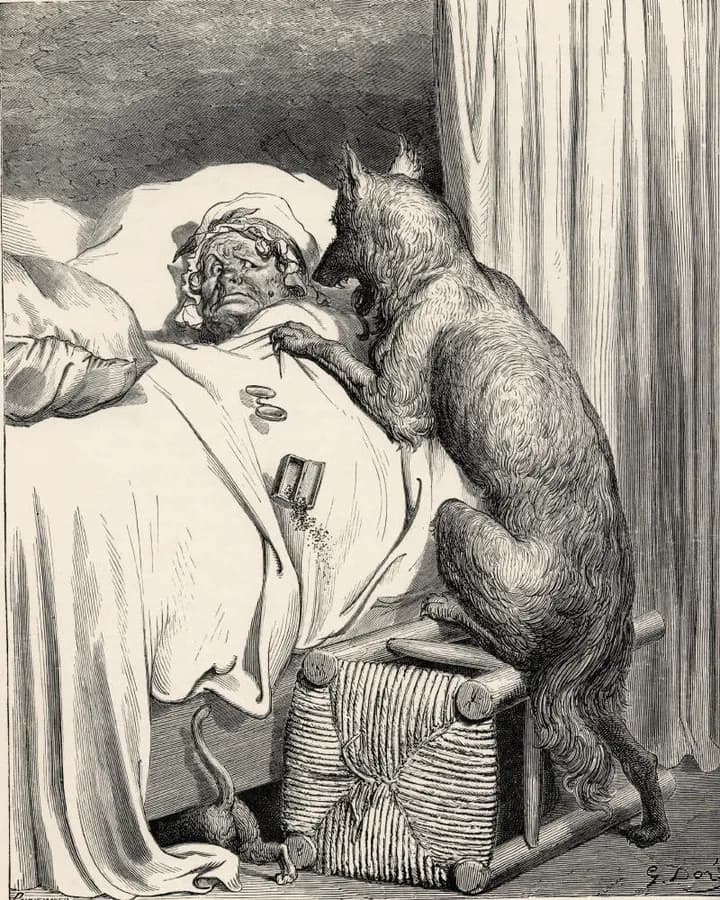
Charles Perrault's Le Petit Chaperon rouge, or Little Red Riding Hood, gives you an advantage before the first sentence. You may already know why a child is talking to a wolf disguised as her grandmother. That leaves more attention for the dialogue. Do not assume that every retelling has the same ending, though: Perrault's tale offers no last-minute rescue by a huntsman.
In the French text included in Project Gutenberg's historical edition of Popular Tales, the child says:
ma mere-grand que vous avez de grands bras!
The spelling and lower-case opening are retained from that edition. In modern spelling, mère takes an accent; mère-grand is an older way to refer to a grandmother. This is a reason to check the edition, not a form to copy unthinkingly into a message to your own family.
The useful pattern is que vous avez de grands bras: roughly, "what big arms you have". Here que introduces an exclamation. Grands bras means big or long arms in this bodily comparison; reading grand as an impressive English "grand" would send the tone in the wrong direction. The reply begins c'est pour mieux, "it's to ... better", and the pattern recurs with different body parts and actions.
That repetition makes this a good first small unit. Read the exchange, follow who is speaking and notice what stays fixed. Then test a new line without looking at an English version. Recognising the plot can help, but it can also encourage you to supply words that are not there.
For a newer learner, choose a modern-spelling, annotated French edition or a clearly labelled adaptation. The linked historical text preserves forms that add avoidable work. The tale is useful because you can limit the task to a few exchanges, not because seventeenth-century prose secretly carries an A1 certificate.
Maupassant: a short story with grown-up dissatisfaction
If fairy tales are not what you want to read, try La Parure in Guy de Maupassant's Contes du jour et de la nuit. Mathilde Loisel longs for a more luxurious life, borrows a necklace for a social occasion and loses it. That is enough plot to understand the pressure of the story without spoiling its final turn.
The French collection on Project Gutenberg gives you this early sentence:
Elle souffrait sans cesse, se sentant née pour toutes les délicatesses et tous les luxes.
A working translation is: "She suffered continually, feeling herself born for every refinement and luxury." The sentence describes her sense of entitlement and frustration. Sans cesse means continually; it is a unit worth recognising together. Se sentant née connects the suffering to how she sees herself. The narrator is presenting a conviction, not handing you proof that she deserves a richer life.
Notice the repeated toutes and tous. Their forms follow the nouns, while the accumulation enlarges the appetite. You do not need to settle every nuance of délicatesses before understanding the contrast between what Mathilde wants and what she has. You do need to keep that contrast intact.
This is a better choice for a reader who wants an adult situation in a compact form and can tolerate descriptions between events. The imperfect tense, social vocabulary and occasional compressed phrasing make it a stretch rather than a first-ever French text. Try the opening before committing to the collection. Some other stories in it have different subjects and difficulties; one accessible passage is not a recommendation for every page in the volume.
An adaptation can shorten the syntax. A bilingual edition can help you check it. Neither should be mistaken for the unabridged French just because the cover uses the same title.
Verne: let dialogue open the door to a longer book
Le Tour du monde en quatre-vingts jours is the longest commitment here. Phileas Fogg's wager supplies a clear practical problem: get around the world within eighty days. Passepartout, his new servant, must adjust to a rather less restful job than he expected. The movement of the plot gives you something to follow when the vocabulary expands.
Do not judge the whole novel by its opening sentence, with its address, historical aside and elaborate introduction to Fogg. In chapter IV of the French original on Project Gutenberg, Fogg's announcement is much more direct:
Nous partons dans dix minutes pour Douvres et Calais.
"We leave in ten minutes for Dover and Calais." Dans dix minutes points forward from the moment of speaking. Partons is the present form of partir with nous, used here for an imminent departure. Knowing the everyday present tense already gives you a foothold. Douvres is the French name for Dover, not an extra mysterious destination.
The short announcement also shows character through action: Fogg delivers a timetable while Passepartout is still trying to understand the change of plan. A learner can follow the immediate exchange without first mastering every descriptive sentence in the chapter.
This makes Verne a possible next project for a reader comfortable with supported narrative, rather than the easiest item on a beginner shelf. Expect geographical detail, descriptions and literary narration around the brisk conversations. Read a complete scene before choosing it. A chapter with several speakers may feel easier than a quiet page devoted to explanation; the number of unknown nouns is only part of the decision.
If you like the premise but cannot yet follow those scenes, a graded version is a reasonable bridge. It should tell you that it is adapted. The original will still be there when the vocabulary budget improves.
Choose the edition before you choose the reading schedule
Easy French books for beginners are often editions made easier for a specific reader: modern spelling, notes, controlled vocabulary or a parallel translation. Check which of those you are getting. The historical texts linked here let you inspect the originals; they do not make every current translation, introduction or annotated edition free to reproduce. Copyright and availability depend on the edition and country.
Pick the smallest useful trial. Perrault offers a repeated exchange; Maupassant offers an adult predicament in a short story; Verne offers a larger plot you can enter through a scene. If none leaves you enough attention to notice what is happening, choose a simpler text without treating it as a demotion.
A contextual dictionary while reading an EPUB can help with a word that blocks the sentence. Use the answer to return to the French. You are choosing a book to spend time with, which is a better ambition than choosing a cover to feel inadequate beside.
LexicAIze invites you to try reading with the original and a translation alongside it. Check a difficult passage, then return to the French and see what now makes sense.
Keep reading

8 min
Books to learn Spanish for beginners: five first reads
Five books to learn Spanish for beginners, with honest difficulty notes, two short passages and a way to choose a first read you can finish.
9 min
Reading books to learn a language: make the page count
Reading books to learn a language works best with a story you can follow. Choose a text, test your understanding and keep a short, useful reading routine.

7 min
Translate an EPUB: four routes and their trade-offs
Want to translate an EPUB? Compare a Calibre plugin, document conversion, a bilingual reader and a downloadable translation before choosing.