Pinocchio in Italian: who spoke in the workshop?
Read Pinocchio in Italian with Carlo Collodi's first chapter. Follow the voices in the workshop and see how repetition makes the original easier to read.
LexicAIze6 min
Read Pinocchio in Italian and the first voice that interrupts the story belongs to an imaginary reader. The second interruption, in a carpenter's shop, comes from somewhere the carpenter can't explain. If the original feels harder than the story you remember, start by tracking who speaks and what they can see. That will get you further through the first chapter than learning the names of all the objects in the room.
Open chapter one of Carlo Collodi's original alongside this page. The workshop has three interruptions, each a little harder for the carpenter to explain away. Once you can hear the difference between those three lines, you can leave a surprising amount of the surrounding Italian for a second pass.
Reading Pinocchio in Italian starts with a wrong guess
C’era una volta is “once upon a time.” Then comes Un re! (“A king!”). The words after it, diranno subito i miei piccoli lettori, tell you whose guess that was. Diranno means “will say,” and its subject comes later, in i miei piccoli lettori. The narrator is predicting what his readers will say and giving them a line before they have a chance to answer. He's also giving himself someone to correct.
C’era una volta un pezzo di legno.
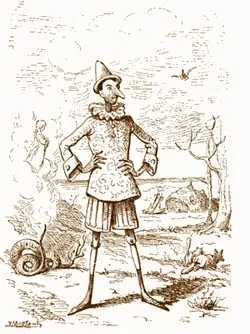
The repeated opening makes the substitution easy to hear. A piece of wood occupies the place where the king ought to have been. Collodi then spends a sentence making the wood thoroughly ordinary. If pezzo da catasta slows you down, the stoves, fireplaces and fire in the rest of the sentence supply what you need. This is the sort of wood you burn. The carpenter plans to turn it into a table leg, which is a decent promotion until he raises the axe.
Listen for the little voice before you name it
Non mi picchiar tanto forte!
“Don't hit me so hard!” The mi tells you the speaker expects to be on the receiving end of the blow. In picchiar, you can recognise picchiare, with its final vowel dropped. Read on for the reaction. Master Cherry looks under the bench, inside a cupboard, in a basket and out towards the street. The repeated e nessuno gives you the result of each search: nobody. One of the pleasures of the passage is how quickly you can follow that inventory once you've spotted the refrain. You can leave trucioli and segatura, shavings and sawdust, until you come back.
After the axe comes down, the voice cries Ohi! tu m’hai fatto male! (“Ow! You hurt me!”). La solita vocina, the same little voice, links the cry to the first interruption. The first line asks the carpenter to stop before the blow. The second responds to what just happened. If you're reading with a translation, check which line you're on before you read its English equivalent. An English page can make both lines obvious while letting the Italian distinction between them go by unheard.
The carpenter tries a different tool. Pialla is the plane he picks up, and piallava describes him using it. Here the action is already underway when the voice interrupts again. This time the wood laughs and tells him to stop because it tickles. Smetti is enough to follow the exchange on a first reading. The rest of the line is worth returning to because the change from pain to tickling tells you something the carpenter would dearly like to ignore. The voice responds to the particular thing he's doing.
Follow the carpenter's explanation as it wears out
Master Cherry twice tells himself that he imagined the voice. The phrase me la son figurata io is worth pausing over the second time it appears. La points back to la vocina, and son is a shortened sono. The explicit io comes at the end. You can hear the insistence of someone making himself responsible for a noise he'd prefer to have made up.
The surrounding actions do as much work as the phrase. The first time, he laughs and scratches his wig. The second time, he has to make himself laugh, and he ruffles it. Between the two he has hit the wood and heard it complain. His explanation stays remarkably steady for a man whose hands don't.
Try reading those two paragraphs together. On the first pass, underline the repeated words. On the second, look for what changes around them. A bilingual edition makes the second pass convenient if you keep your place on the Italian side. How to choose a bilingual edition goes into the practical differences between facing pages and other layouts.
Decide how much of the original to tackle
Start with the first interruption and the search that follows. After one reading, see if you can tell someone what the carpenter did and why he did it. If you can follow that sequence with two or three glosses, carry on to the axe and the plane. If every paragraph sends you back to the translation, take just the two appearances of e nessuno you find easiest to locate and read those aloud with the actions before them. Familiarity with the plot won't supply the vocabulary of an old workshop.
Collodi writes for children, and the opening has short bits of dialogue you can follow early on. The paragraphs between them can be a different proposition. The first description of the carpenter is a good test. You can understand his nickname from ciliegia, cherry, and come back later for the exact shade of his nose. Save your attention for the words that tell you somebody has spoken or that the carpenter is about to do something.
By the last interruption you know enough Italian to predict trouble from a tool and a short verb. The carpenter, who knows the name of every tool in the room, is still trying to work out where the sound came from.
Try a short passage from an Italian EPUB in LexicAIze. Keep the translation beside the original so you can go back to the line where the speaker changes.
Keep reading

8 min
Kafka in German: reading the first sentence closely
Read Kafka in German through the opening of Die Verwandlung: follow the verb, question Ungeziefer, and see what an English translation has to choose.
9 min
Reading books to learn a language: make the page count
Reading books to learn a language works best with a story you can follow. Choose a text, test your understanding and keep a short, useful reading routine.

8 min
Books to learn Spanish for beginners: five first reads
Five books to learn Spanish for beginners, with honest difficulty notes, two short passages and a way to choose a first read you can finish.